
Widows & Widowers Support Group
This community is dedicated to those who have lost a husband, wife, or partner. Anything is open for discussion here, with the hope that we can focus on grief, bereavement, life after loss, and continuing on after a great loss.

by: ELEANOR HALEY Original Post Link: When Feeling Okay Feels Wrong
I look at grief as more of a frienemy than anything else. To be honest, it’s been this way since day one. That’s not to say my relationship with grief hasn’t changed over time, it has immensely. But no matter how much emotional torment grief has laid upon me, even in the early days, I’ve never truly wanted it to go away. Did I regret the necessity of its existence? Heck yes. But if my mother was going to be dead, then doggone it I was going to grieve her.
I know this sounds extremely counter-intuitive to many people because for so long our society has conceptualized grief as something to be resolved. Grief is painful, right? Especially acute grief. Aren’t humans hardwired to try to avoid pain? Why would grief be any different?
It’s kind of hard to explain, but even when grief was extremely painful, I didn’t want to escape it. I guess at the time, as terrible as grief felt, it also seemed like my memories and connection to my mother existed within it. My grief became an ongoing vigil, allowing me to stay focused and devoted to my mother’s memory for as long as her death warranted.
Grief is often confounded by the grieving person’s preconceived beliefs, attitudes, and expectations around it. Many people believe grief and pain have to end before they can feel better and the only way to make this happen is to “let go”. A pretty significant cognitive shift must occur (and often a lot of struggle) before a person realizes that pain and grief are not synonymous and grief and healing are not mutually exclusive.
When my mother died, I didn’t know any of this. I felt like my love for my mother was defined by my pain and suffering. My mother’s death was devastating, so it was only right that I should feel devastated for a devastatingly long time. For me, feeling okay seemed like getting over it or moving on, which I wasn’t ready to do. Not only did feeling better feel inconceivable, but it felt wrong.
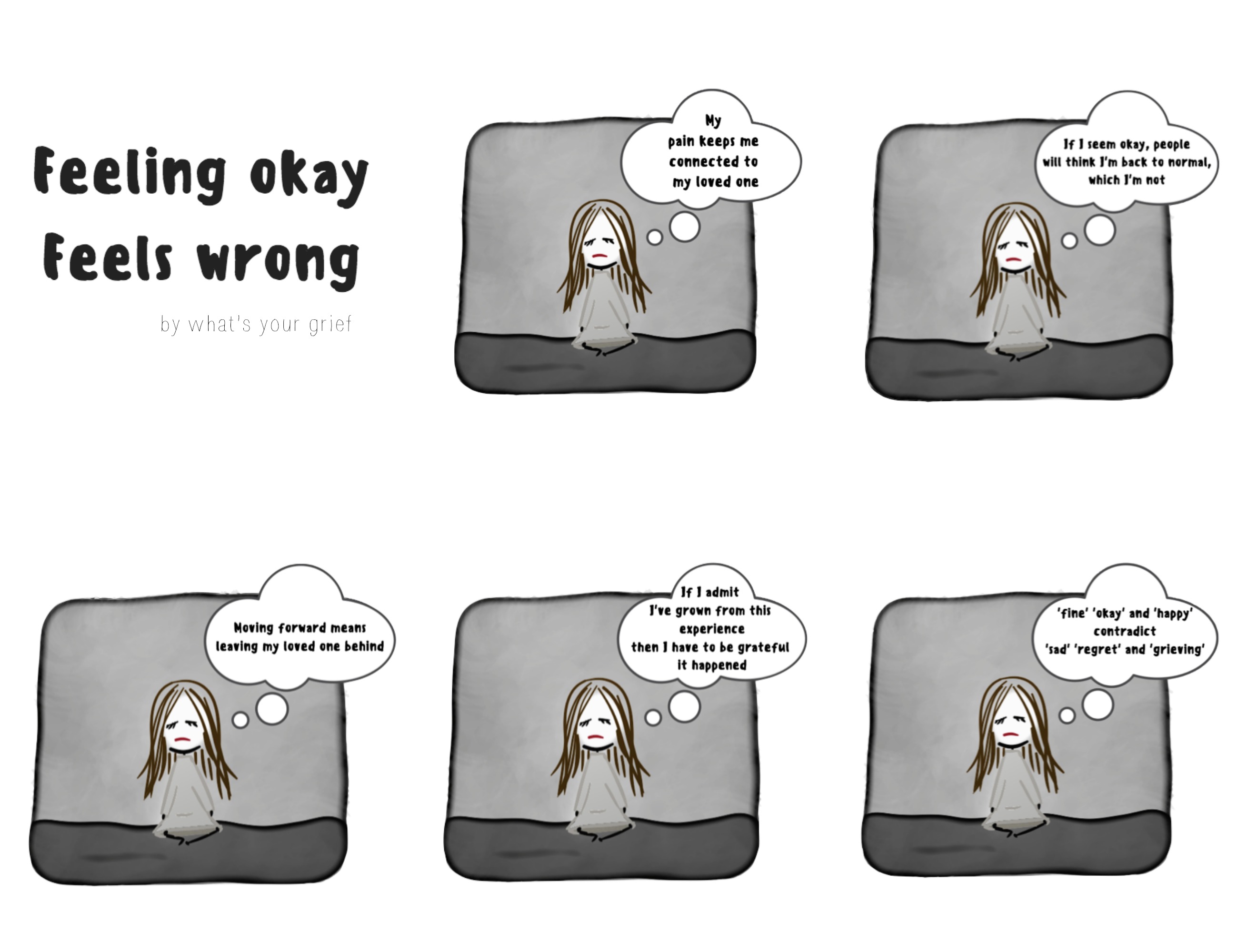
I didn’t understand that I would feel the aftershocks of my mother’s death for the rest of my life, so feeling it all upfront wasn’t even an option. I didn’t realize that “getting over it” and “moving on” weren’t even a part of the process. I didn’t know that a person could bring their loved one with them as they move forward in life. I didn’t know that my grief would eventually become a part of my okay-ness.
I didn’t know a lot of things and if at the time you had told me all the things I didn’t know, I wouldn’t have believed you. These are realizations I had to come to myself. I get that. Just as my words here can’t make these realities any more true or attainable for you, but maybe they can offer some hope.
Recently I’ve seen a few people comment that they can’t acknowledge positive healing or find things to feel grateful for in their lives because, if they do, it means they are somehow okay with their loved one’s death. This thought process is normal and natural in grief, it’s also one that I hope our readers are able to eventually put into perspective as they come to their own realizations about grief and their continued bond with their loved one.
I understand why grieving people feel put off or like they can’t relate to words like ‘growth’ and ‘healing’, especially in the early days of grief. When you feel terrible, these concepts are annoying, but even if you’re not open to these concepts now, I hope you’re open to being open to them someday (baby steps).
I’m not asking you to plant flowers, I’m asking you to believe in the possibility that they could grow even in darkest shadows of your grief. And just remember, never in a million years would you have chosen to pay the emotional toll you’ve had to pay, but the path was chosen for you. Any posttraumatic growth you experience at this point is merely a byproduct of you coping with the only choice you were given – to persevere.
This is a concept we’ve written about before. No matter where you are in your grief, you may find the following articles helpful.
(Link) The Truth About Posttraumatic Growth
(Link) Grief and the Fear of Letting Go
(Link) The Reality of Growth and Grief: Where the hell is my rainbow?
(Link) "Maybe, Someday”: Staying open to possibility
(Link) Coping with the Conflicting Emotions of Grief
While I'm celebrating that he inhabited the body that was here with me, I'm also keenly aware that his body is gone. A mixed bag to be sure.
Ed, Thanks again for important information. Hugs, Dolores