Friends til the end Community Group
A group for those of us here who get more from our friendships than from the available discussion groups. A place to be accepted and appreciated for who we are. Somewhere to always feel safe and know that especially on the bad days we are here for each other .A place for encouragement and love.

I've been struggling a great deal lately. My goals and values are forever changing. I'm not who I was at age 17, 25, 35 or 45. Life and all its wonders has made me question who am I right now. This fun quiz was kinda right, but I will keep searching. Who are you per this quiz?
https://www.quizexpo.com/who-am-i-quiz/
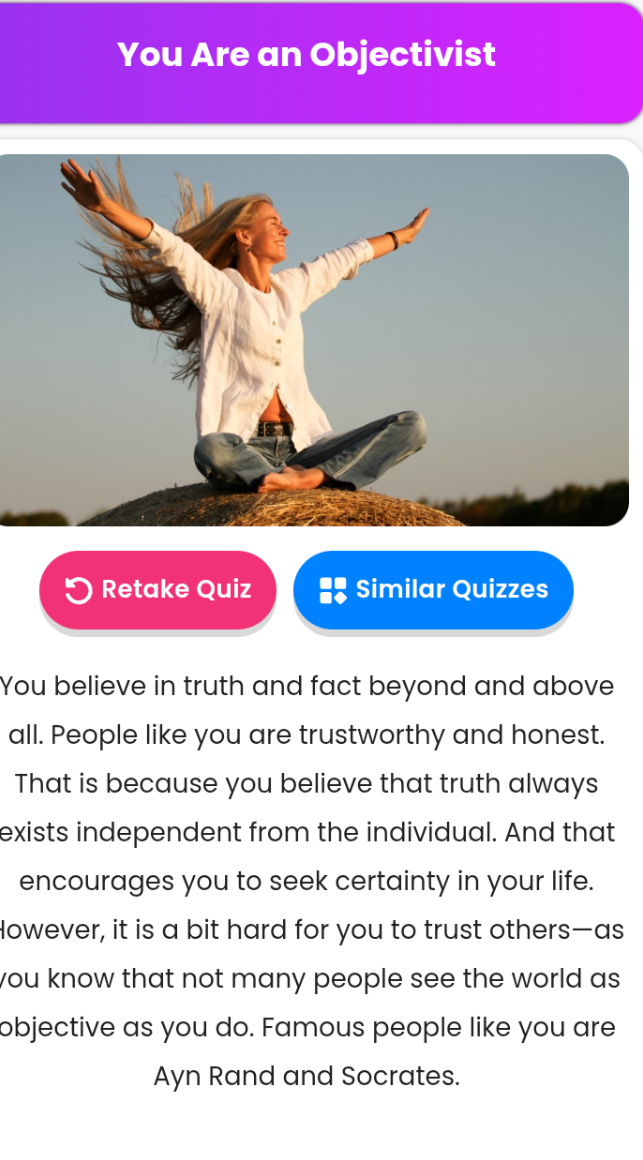
My result is Objectivist
-
Hey all, i know its been quite awhile since i posted on here. Its been a summer all right. Its been something else........... You know how they say not to open the can of worms? Well a few months ago i decided to find out what my due date would have been for my first baby, the one conceived by r***. My baby would have been due on March 4th of 2006. They would be 20 years old. I was R**** on June...
-


I bailed out! Too strange for me
Odd thing, I took a different quiz this morning and was listed as a 4 versus a 7. I feel your mood may determine how you answer the questions
Here's another article I found about Enneagram Types:
https://enneagramacademy.com/enneagram-types/
The Enneagram is a model of the human psyche that categorizes people into nine interconnected personality types. It is often used for personal development and understanding interpersonal dynamics, although it is considered pseudoscience by many experts.
Overview of the Enneagram
The Enneagram is a model of the human psyche that categorizes individuals into nine interconnected personality types, known as "enneatypes." This system is represented by a geometric figure called an enneagram, which illustrates the relationships between the different personality types.
Personal Development
The Enneagram is often used for:
Gaining insights into personal behavior
Enhancing self-awareness and self-understanding
Business Context
In business settings, it is promoted as a tool for: understanding workplace interpersonal dynamics
Criticism and Acceptance
Despite its popularity, the Enneagram is considered pseudoscience by many experts. There has been limited formal psychometric analysis, and the peer-reviewed research supporting it is not widely accepted in academic circles.
Historical Background
The contemporary Enneagram is largely derived from the teachings of Oscar Ichazo and Claudio Naranjo, who developed the model in the mid-20th century. Naranjo's work was influenced by earlier ideas from George Gurdjieff, who first introduced the geometric figure of the enneagram but did not create the personality types associated with it.
Popularity Trends
Interest in the Enneagram has surged since 2017, particularly among millennials, paralleling a broader resurgence in interest in personality assessments
You believe that humans are the source of morality. And your actions, thoughts, and behaviors show that you value dignity, morality, and responsibility more than anything else in your life. Thanks to your humanistic behaviors, it is easy for you to build healthy relationships. And you are also good at socializing and making new friends. Famous people like you are John Dewey, Katharine Hepburn, and Kristen Bell.
For kicks I took the quiz. Says I’m a “Relativist.” It’s fairly accurate for me I gotta say. Here’s the description:
You are a rational person. It is easy for you to admit your faults and accept the fact that humans are imperfect. You do not put unnecessary effort into finding the ultimate truth—as you know that there is no such thing as the divine truth. A relativist believes that objectivity is an unachievable state. And that makes you an open-minded person. Famous people like you are Noam Chomsky and Plato.
You know the older I get the more comfortable I am with myself. When I was younger I was a seeker, always trying to find my place, my footing, almost fighting against everything. Exhilarating but kind of futile sometimes.
In my 50s and now as I sit here at 61, I feel more philosophical but sometimes question if the comfort that comes with that is just complacency in disguise. I don’t know honestly. I still question things. I still try to challenge my thoughts and my views or desires but differently. I’m probably more curious now than ever but the curiosity doesn’t feel as burdensome, confusing and urgent as it did when I was younger. It feels more like almost wonderment or an internal “hmmmm.”
I think for me it’s ultimately making peace with not everything is gonna make sense and not everything is gonna turn out the way I’d hoped or planned. And none of it is personal.’ So why not just accept the mystery of it all.
I don’t know if you are familiar with Rainer Maria Rilke and his “Letters to a Young Poet” but this line has resonated with me through the years especially when I fundamentally could not make sense of loss or the stuff that would sort of throw me off balance.
“Let life happen to you. Believe me: life is in the right, always.”
I interpret that my own way and I really lean in to it more than ever. It’s kind of been my North Star through a lot of ups and downs.
Embrace turning 50. Beats the alternative and nothing like getting to a place where you truly can be unapologetically who you want to be. My give a F%^* left the building once I hit 50, in the best way.