Playground Surfaces Are Most Fun When They Are Safe
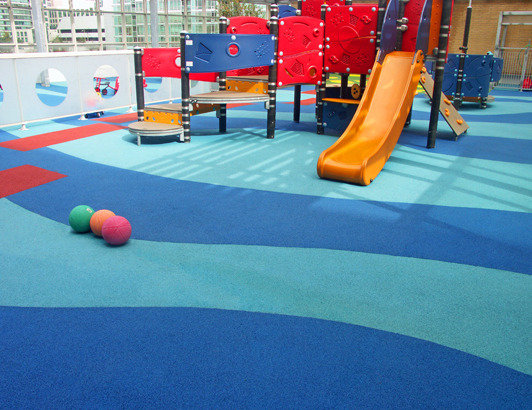
Playground designs and overall structure have changed over the years and in the process it has also been influenced by foreign countries’ concepts. One thing that has stayed the same and is also the constant worldwide is the children’s safety. Be it commercial playgrounds, school places or public service projects, safety is the primary concern for all. The first step in achieving a safe playground is to make its surface secure for fall height as well as slip-resistant. With playground equipment in place, ensuring fall height security becomes even more important.
The guidelines for making a playground safe start with achieving the appropriate thickness of the surface. Meeting these guidelines is not only needed to ensure that children are safe but it is only necessitated by the fact that most of the injuries caused on a playground are a result of falling from a considerable height. While maintaining the size of the playground equipment is the first important step in ensuring against serious injuries, the thickness and shock absorption capacity of the surface cannot be given any less importance.
That said, there are many options to choose from. Some of the conventional materials used for playgrounds’ flooring are woodchips, sand, gravel and so on. All these have several benefits, but all of these fall short of the maximum protection that can be achieved with modern day availabilities. Poured in surfaces and rubber are the most appropriate for this use as their thickness and the material itself is capable of fall protection and is slip resistant among other things. Furthermore, unlike other alternatives, rubber does not come off at the ends or at the junction points which further reduces the risk of tripping or getting injured due to uneven surfaces.
Even though the playgrounds are mostly focused for kids, the public places are open to and intended for all age groups. Uneven surfaces also tend to hinder the wheel chair movement which makes it less accessible for disabled people. Therefore a smooth surface provides advantages even beyond just fall protection. Another popular material is synthetic turf which is also primarily composed of rubber, hence offers all the advantages that the poured in surfaces provide.
Artificial grass is another popular option. However it presents the risk of moisture affecting its ability to cushion and provide slippery surface. In rainy areas or places where the playground surface frequently comes into contact with moisture, for instance if there is a fountain in the area, the artificial grass tends to perform less than optimum. The foam padding for playground however solves this problem as well.
Artificial turfs are also among the popular choices of materials. It is also considered a greener option. This also contains a rubber component but with its natural appearance it also fits the environment friendly criteria as well as the modern designs. Also its manufacturing primarily involves the products that are eco-friendly which makes it a preferable choice for global environmental agencies as well as those who are concerned with the environment protection.
Rubber surfaces are themselves eco-friendly and coupled with the fact that they are available in unlimited shapes, sizes, thickness and an array of colors, they remains the preferred choice of domestic and commercial users alike. It is also cost-effective as it does not need a heavy installation expense and since it is more durable than most of the alternatives, it also requires less replacement costs. All in all foam padding for playground surfaces provide security, attractive appearance and cost savings all together.
Replies