How Traditional Chinese Medicine Approaches Emotional Wellbeing and Stress from the Inside Out
If you already use breathwork, yoga or the occasional acupuncture session to manage life's pressures, you have probably wondered what is actually going on underneath those practices. Traditional Chinese medicine for stress and emotional health works from the inside out: rather than quieting a symptom, it asks what internal pattern is generating it in the first place. That perspective turns out to be surprisingly practical for everyday emotional ups and downs.
This article unpacks the key TCM ideas you need to make sense of that approach — qi, yin-yang balance, organ-emotion links and the difference between treating a symptom and treating its root. It then maps those ideas onto the stress patterns many people recognise in their own lives, offers a handful of gentle self-care practices you can try safely at home, and describes what working with a Catching Young practitioner alongside your existing care might look like.
How Traditional Chinese Medicine Approaches Emotional Wellbeing and Stress from the Inside Out
Key TCM foundations for understanding emotions and stress
TCM describes the body as an interconnected network in which physical, mental and environmental factors continuously influence one another. At the centre of this network is qi, often translated as vital energy or life force. When qi moves smoothly through the body's channels, people may feel physically and emotionally balanced; when it becomes blocked or depleted, mood changes, tension and fatigue can follow. This is not a biomedical claim about anatomy — it is a traditional framework for observing and organising patterns of health.
Yin and yang describe the dynamic qualities within that system. Yin represents cooling, nourishing and restful qualities, while yang is warming, active and outward-directed. TCM frames many emotional swings — wired but exhausted, flat then suddenly irritable — as signs that this balance may have tipped in one direction.
The organ systems at the heart of TCM, the zang-fu, extend well beyond physical anatomy. Each system carries emotional, mental and even what TCM calls spiritual dimensions, so emotional experience is woven into the body's own map rather than sitting separately in the mind. The Heart, Liver, Spleen, Lung and Kidney each have associated feelings that belong to this picture.
Practitioners use this map to distinguish the 'branch' — the immediate symptom such as poor sleep or irritability — from the 'root': the underlying pattern in qi or organ function that keeps producing those symptoms. Addressing only the branch may bring short-term relief; working on the root aims for more lasting change. Most people exploring this approach do so alongside, rather than instead of, their GP, therapist or existing medical care, and that collaborative stance is exactly how TCM is most sensibly used.
The classic TCM organ-emotion map: linking feelings with inner systems
The organ-emotion connections in TCM offer a rich language for mind-body experience. They are not diagnostic categories in the Western medical sense; rather, they are a holistic map that some people find genuinely meaningful when they start noticing patterns in themselves.
The Liver is associated with the smooth flow of qi through the body. When life is chronically pressured and qi becomes constrained, TCM suggests people may notice irritability, a sense of feeling stuck, sighing, tight neck and shoulder muscles, or mood shifts tied to the menstrual cycle — a pattern sometimes described as Liver qi stagnation.
The Heart relates to circulation and to what TCM calls the shen, loosely translated as spirit or mind. Both a flatness or absence of joy and a restless, scattered anxiety are seen as Heart imbalance patterns. When the shen is settled, the mind tends to feel clear and calm; when it is disturbed, racing thoughts and emotional fragility often follow.
The Spleen governs digestion and the transformation of food into qi. Overthinking, rumination and that foggy, heavy-headed feeling that builds after long periods of worry are traditionally linked with Spleen qi being weakened — and it is not coincidental, in TCM's view, that people who are chronically anxious often also have sensitive digestion.
The Lung governs breath and is associated with boundaries and letting go. Prolonged grief, difficulty releasing loss or feeling emotionally shut down after a significant change are linked in TCM with Lung qi being affected. The Kidney, seen as the body's deep reserves, is connected to fear and a sense of inner resource, so long-term stress accompanied by fatigue, low resilience and a feeling of running on empty may be framed as signs that Kidney energy is being taxed.
It is worth saying clearly: noticing that you feel stuck and frustrated does not prove anything is wrong with your physical liver. This map is a clinically-used language for mind-body connection, not a literal claim about organs. Its value lies in how it guides a practitioner's observations and helps individuals make sense of the relationship between how they feel emotionally and how they feel in their body.
How modern stress patterns may show up in TCM terms
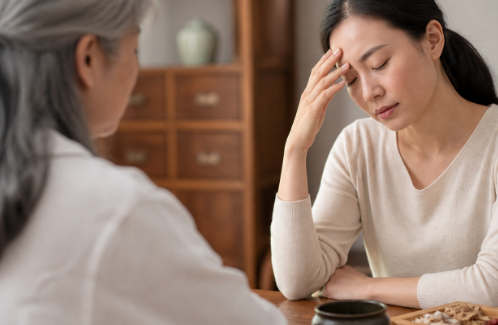
TCM patterns translate naturally into the kinds of stress most people in busy, pressured lives actually experience. Liver qi stagnation is perhaps the most commonly encountered: people may report moodiness, a low threshold for frustration, tight shoulders and neck, a tendency to sigh, or menstrual tension that worsens during stressful periods. In TCM terms, qi is simply not moving freely enough and the system has become congested under sustained pressure.
Heart shen disturbance tends to surface when stress has been intense or prolonged, or after an emotional shock. Experiences that may fit this pattern include palpitations, a racing or circular quality to thoughts at night, vivid or unsettling dreams, and a sense of emotional fragility that feels out of proportion to circumstances.
Spleen qi deficiency often develops quietly through overwork, irregular eating and chronic worry. Someone in this pattern may feel bloated or uncomfortable after meals, mentally foggy, tired but oddly wired, and prone to going over the same worries repeatedly without resolution. Lung-related patterns can appear after grief or big life transitions — a tightness in the chest, feeling low in voice or energy, or a tendency to withdraw. Kidney-related depletion may show up as deep fatigue, low back achiness and a difficulty bouncing back after difficulty.
These are descriptive frameworks a practitioner uses to shape a personalised approach, not labels to self-diagnose from. If you recognise yourself in more than one pattern, that is common, because they frequently overlap. Persistent or severe symptoms, including significant anxiety, low mood or sleep difficulties, should always be discussed with a GP or mental health professional. TCM patterns and Western diagnoses can co-exist, and a good practitioner will encourage that conversation.
How modern stress patterns may show up in TCM terms
Inside-out tools in traditional Chinese medicine for stress and emotional health
The TCM toolkit for stress and emotional wellbeing combines several approaches, often used together, each working at a different level of the body-mind system.
Acupuncture involves the insertion of very fine needles at selected points along the body's channels, with the aim of regulating qi flow, calming the nervous system and supporting specific organ-emotion patterns. In emotional wellbeing work, points are commonly chosen to soothe Liver qi, settle the Heart shen or strengthen the Spleen. Some research suggests acupuncture can reduce physiological stress markers including heart rate and cortisol levels, and many people report feeling calmer, more grounded and better able to sleep following a course of sessions.
Chinese herbal medicine works through carefully chosen combinations of herbs selected to match an individual's pattern. Commonly used formulas include preparations aimed at supporting Spleen qi, nourishing Heart blood or easing Liver constraint; but the specific combination shifts depending on the person. Herbs can have strong effects and may interact with other medicines, so formulas and doses should only be prescribed by a qualified practitioner and should not replace prescribed medication without medical advice.
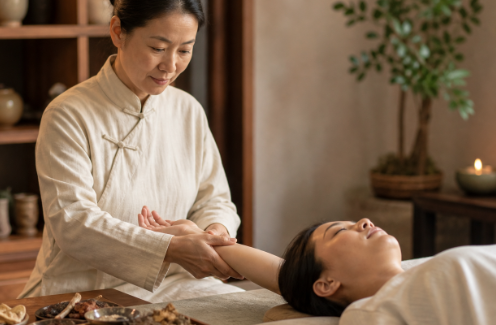
Qi-focused movement and bodywork, including acupressure, tuina-style massage, qigong and taiji, aims to move stuck qi, relax the body and gently balance yin and yang. Evidence suggests that mind-body practices such as qigong and taiji may improve mood, reduce perceived stress and support sleep. They are also accessible: even a few minutes of slow, intentional movement can shift the body's state.
Lifestyle and mind-body guidance rounds out the TCM picture. Sleep timing, meal regularity, workload, breath patterns and time spent in nature are all considered part of the therapeutic approach. Practitioners tend to suggest small, realistic shifts — for instance, warm and regular meals to support the Spleen, or a slower evening routine to help settle the Heart shen. As with all of the above, these approaches are most useful as part of a broader self-care plan that sits comfortably alongside therapy, medication or other support.
Gentle TCM-inspired self-care you can explore at home
These practices are simple, non-invasive and draw on TCM principles. They are general wellbeing suggestions, not a substitute for professional care. If you are pregnant, have significant health conditions or are unsure whether something is appropriate for you, check with a clinician first, and stop any practice immediately if you feel discomfort.
For Liver qi: try a simple breath-and-acupressure practice. Place your fingertips gently in the soft web between your thumb and index finger, or in the slight depression between your big toe and second toe, and take slow belly breaths for one to two minutes, softening any tension on each exhale. Many people notice a gentle easing of tightness with this combination. Avoid firm pressure on these points during pregnancy.
For general qi movement: take a brief daily movement break. A few minutes of slow shoulder rolls, side stretches, gentle shaking through the arms and legs, or beginner-friendly qigong — widely available through free videos — can help many people feel less stuck and more present after long periods of sitting. The emphasis is on slowness and ease rather than intensity.
For Spleen support: try eating regular warm meals without screens. Pausing during meals and taking a short walk afterwards are habits that fit naturally into most routines and may help reduce that foggy, heavy quality that often builds through a day of worry and rushed eating.
For Heart and Lung: build a short wind-down practice in the evening. Spend five to ten minutes with your hands resting over your chest, lengthening your exhalations deliberately, and perhaps noting three emotions you felt during the day. Some people find this helps integrate the day's feelings rather than carrying them unprocessed into sleep.
Seek prompt medical or psychological help for severe, escalating or persistent distress. These gentle practices can support everyday emotional maintenance, but they are not suited to — and cannot replace — professional support when it is needed.
What working with Catching Young can look like on your emotional wellbeing journey
A Catching Young practitioner's role is to listen carefully to your story and observe through a TCM lens — tongue appearance, pulse quality and the patterns across your sleep, digestion, energy, menstrual cycle and emotional life — before working with you to identify the underlying patterns connected to your stress and mood.
A session is unlikely to feel clinical. You would typically spend time talking about what is happening in your life — work pressure, relationships, sleep quality, how your body feels day to day — alongside a gentle physical assessment. From there, a personalised plan takes shape, which might include acupuncture, herbal support, bodywork, movement guidance or lifestyle suggestions, introduced at a pace that suits your comfort level and circumstances.
Catching Young's approach is collaborative and trauma-aware. Practitioners aim to create a calm, respectful space where consent is invited at each step: before needling, before touch, before any shift in the plan. If you already work with a GP, therapist or other healthcare provider, Catching Young practitioners are open to coordinating with that team, with your agreement, so that your TCM support fits into rather than competes with your existing care.
It is worth being honest about expectations: TCM does not offer quick fixes and individual responses genuinely vary. What many people value is having a whole-body, organ-emotion framework that helps them understand their patterns and make small, consistent changes — not as an alternative to mainstream care, but as a thoughtful complement to it. If you are curious about applying these principles to your own situation, exploring Catching Young's resources or booking an initial consultation is a straightforward next step to find out whether this kind of support feels right for you.
Replies